
I have always wondered about loneliness, probably because I have felt it even when I was surrounded by other people. While I realized that I alone must take ownership of my life and figure out a way to connect with people on a more meaningful level, I always felt that there was more to it. On the surface, I could talk to anyone, and simple chatting came easily, but so many times my interactions rarely went beyond niceties. People would ask me how I was able to approach almost anyone with small talk so comfortably. I would say it is easy because it is surface level and I risk nothing. My problem was how to get to more authentic and deeper connections in environments that do not make it easy to do so.
Living in a capitalist society, there is always competition driven by self‑interest, so at work it is in everyone’s best interest to keep some of their authentic selves hidden from view. I never really understood corporate slogans like “Bring your Authentic Self to Work,” because I knew my spontaneous authentic self would probably get me in trouble. In my personal life I rarely hold back from saying what I think, which is not welcomed in a corporate environment. Some will argue that it is not true, that “we want to hear from everyone,” but in my opinion this is dishonest. I suffered consequences early on in my work life and learned to keep quiet most of the time. The act of keeping quiet was likely the start of my struggles with loneliness during working hours and my motivation for exploring this topic at length.
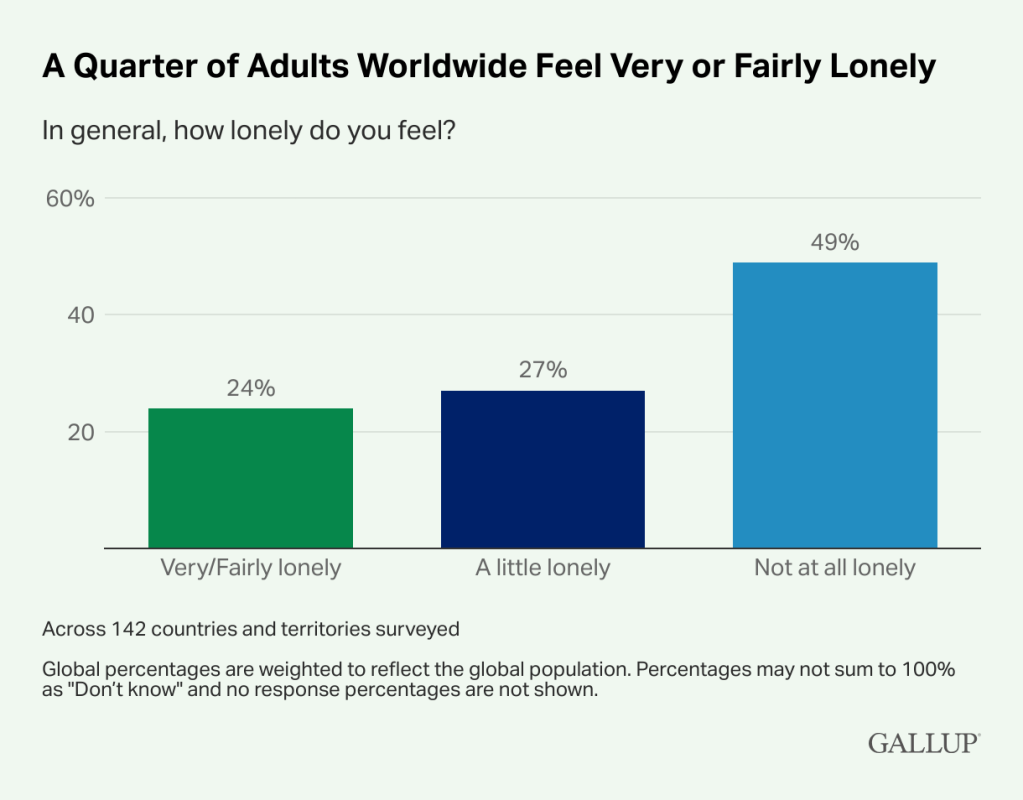
In 2023, Gallup and Meta published a study, The Global State of Social Connections, showing that almost a quarter of the global population (excluding China) felt “very” or “fairly” lonely. Across all 142 countries, the variables associated with loneliness are overwhelmingly structural, not psychological.
The five common variables that affect loneliness in people’s lives are used to explore loneliness at work:
- Social Density: How many chances you have to interact with coworkers during your day—meetings, team projects, or casual conversations. If the focus is only on following rules, these interactions can feel forced or superficial.
- Institutional Continuity: How steady your team, routines, and company policies are, such as having regular check‑ins or long‑term coworkers. When routines are rigidly enforced for compliance, relationships can feel transactional instead of genuine.
- Mobility Constraints: How easy it is to move around, join different teams, or access shared spaces—like visiting other departments or working remotely. Strict rules or limited flexibility can make it harder to connect with others.
- Community Architecture: How your office or company is set up—whether there are open spaces for gathering, quiet areas for focus, or digital tools for connection. If spaces are designed mainly for oversight and control, people may feel watched rather than welcomed.
- Daily Interaction: The quality and frequency of everyday moments—greetings, casual chats, shared breaks—that help you feel part of the team. When every interaction is about compliance or performance, it’s harder to build real trust and belonging.
A lot of times companies try to create environments where people feel more connected. In the companies where I worked, there were various initiatives like “Bring your Authentic Self to Work” and moves from cubes to open work environments like bullpen seating. From my own experience, I ended up feeling more guarded in a bullpen environment, which is not unique because it reflects a broader challenge faced by employees in many large organizations.
Research and workplace observations show that while open office layouts are intended to foster collaboration and frequent interaction, they are often built for compliance. Open offices can inadvertently create a climate of constant observation and subtle pressure to conform. In such settings, employees may suppress their individuality and hesitate to share unconventional ideas, fearing judgment or exclusion.
It reminds me of Kafka’s stories, which describe characters trapped in big, confusing systems where they feel watched, judged, and unable to be themselves. His stories help explain how, in large companies or open office environments, people can feel lonely and lose their sense of autonomy—not because they’re physically alone, but because they feel they must fit in and hide who they really are.
As organizations strive to build more connected and resilient workplaces, it becomes clear that true social connection requires more than just physical proximity; it demands a thoughtful balance between openness, privacy, and the freedom to express one’s authentic self.
Organizations that genuinely improve connections don’t just add social events or open up workspaces—they pay close attention to the underlying dynamics that shape how people relate to one another. This means recognizing that connection is not simply about proximity or frequency of interaction, but about creating an environment where people feel psychologically safe, respected, and able to express their authentic selves. Leadership plays a critical role: when managers model vulnerability, admit mistakes, and invite honest feedback, it signals that authenticity is valued over conformity.
Nuanced connection‑building also involves addressing structural barriers, like rigid hierarchies, inaccessible meeting formats, or unspoken norms that discourage dissent. Companies like Patagonia foster connection by aligning work with shared values and purpose, so employees feel part of something meaningful rather than just another cog in the machine.
Ultimately, improving connection is an ongoing process of balancing openness with privacy, routine with flexibility, and group belonging with individual autonomy. The most successful organizations are those that continually adapt, listen, and create space for real human experience not just surface‑level interaction.

 Valorisa